Research Ethics for All (RE4ALL) provides accessible research ethics education for community research partners, including people with developmental disabilities.
Project Facts
- Project
- Research Ethics for All (RE4ALL)
- Principal Investigators
- Katherine McDonald and Ariel Schwartz
- Institution
- Syracuse University
- Funder / Award
- Patient-Centered Outcomes Research Institute (PCORI), Engagement Award Project
- Grant Size
- $249,999 original award; $300,000 expansion award
- Project Period
- 2021–2026
- Project Type
- Accessible online research ethics training platform
- My Role
- Digital strategy, information architecture, user experience and interface design, custom WordPress development, accessibility, document remediation, and ongoing platform expansion
- Keywords
- Research ethics · Community-engaged research · Developmental disabilities · Accessible training · Online learning · Research partnerships · WordPress development · PCORI
- Website
- re4all.org
The Project
RE4ALL was created by people with developmental disabilities, disability service providers, researchers, and IRB administrators and members. Its goal is to make research ethics education more understandable and usable for people who are often asked to participate in research without being given equally accessible opportunities to learn how that research works.
We worked with the RE4ALL team to translate a substantial body of training content into an accessible online experience that supports both independent learners and facilitated research teams.
The Challenge
Research ethics is not simple material.
Learners need to understand concepts such as scientific research, informed consent, participant protections, privacy, research-team roles, conflicts of interest, and IRB requirements. The website also has to serve several different audiences at once: community research partners completing the training, researchers and trainers facilitating it, and institutions deciding whether the program is appropriate for their projects.
That made this more than a web-design problem.
The experience needed to make a large amount of information feel predictable, manageable, and easy to navigate while preserving the depth required for meaningful research ethics education.
Accessibility could not be treated as a final compliance check. It had to shape the structure of the training itself.
Creating a Clearer Learning Structure
One of the most important parts of the work was creating a consistent architecture for the online training.
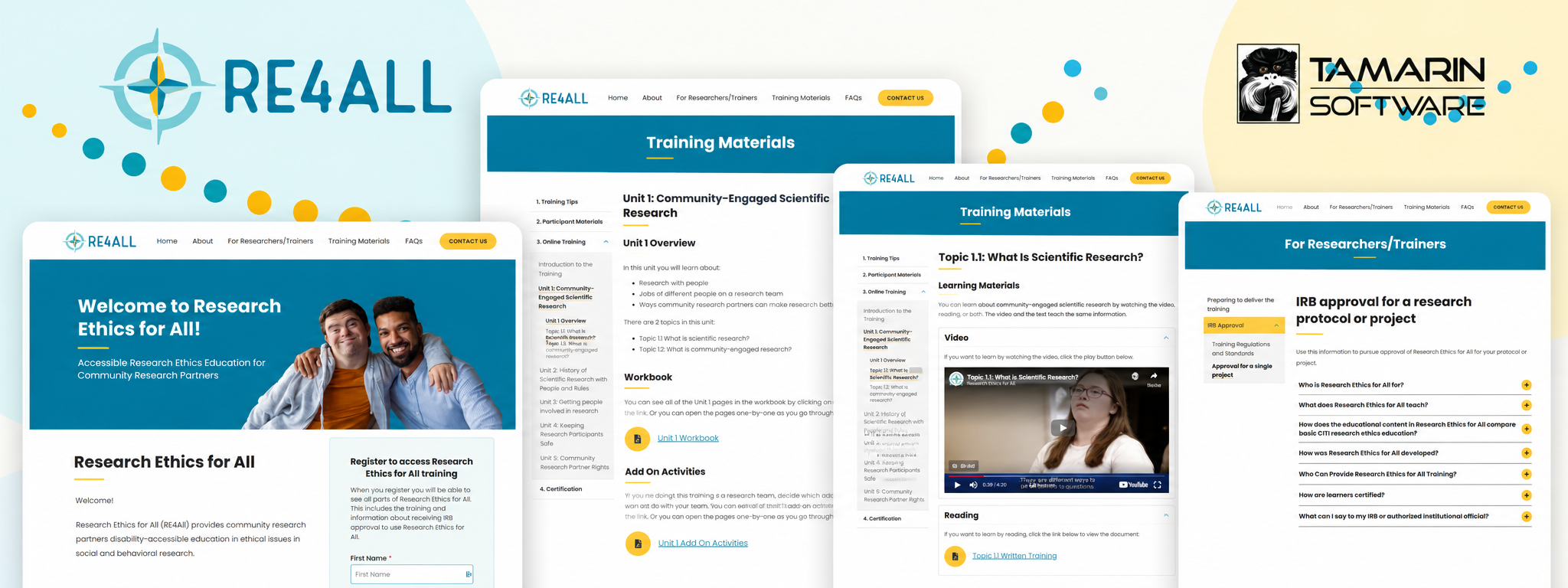
Each unit follows a recognizable pattern, with an overview, individual topics, multiple learning formats, review materials, discussion questions, workbook resources, add-on activities, and clear directions about what comes next.
Persistent unit navigation helps learners understand both where they are and where they are going without having to rediscover the structure on every page.
That consistency matters in a long training program. Instead of making learners decode a new interface repeatedly, the website allows the interface to become familiar so they can focus on the content.
Supporting Different Ways of Learning
RE4ALL does not assume that every learner should receive information in the same format.
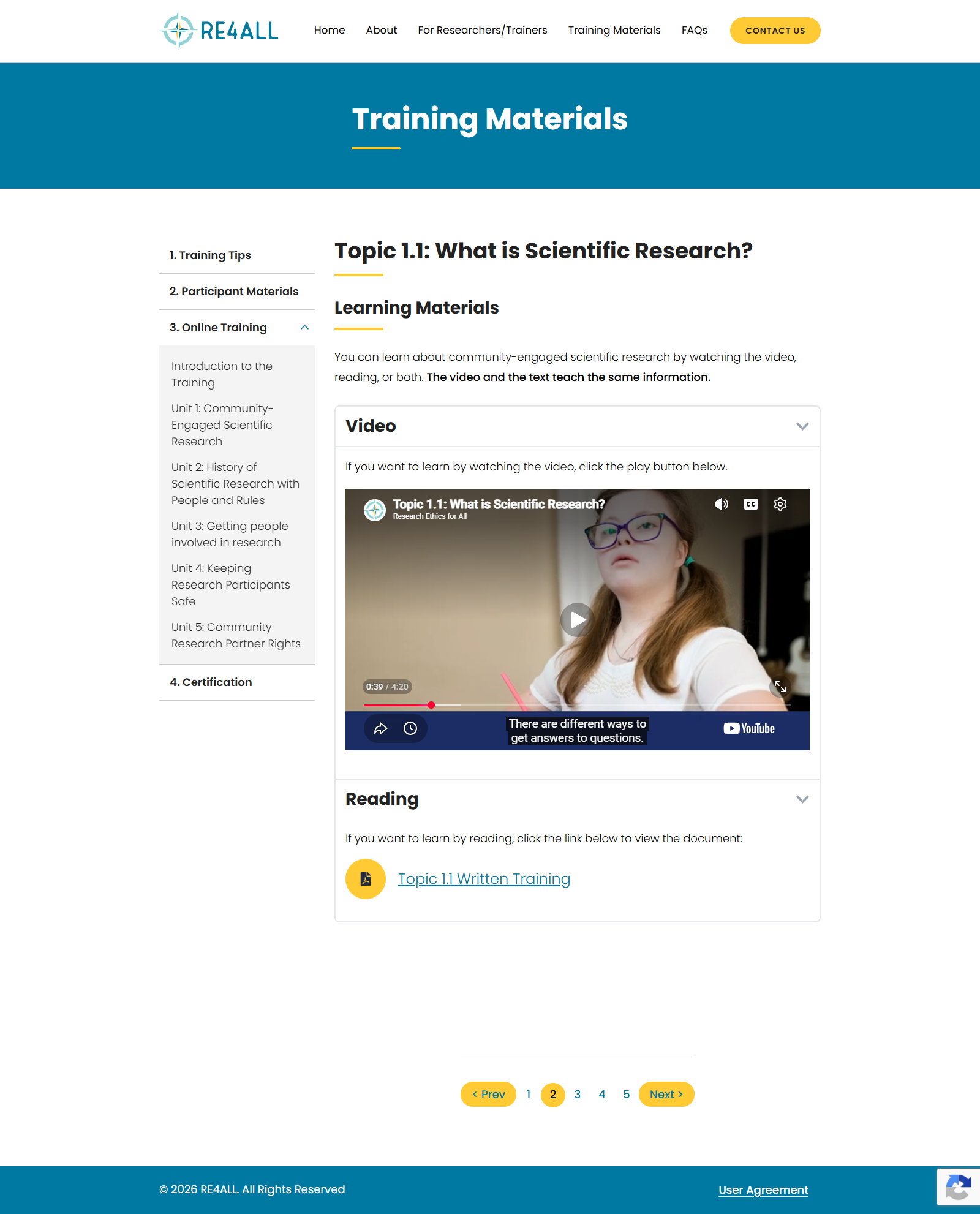
Individual topics are available in both video and written formats, allowing learners to choose how they want to engage with the material. The video content includes captions, while the written training provides the same information in document form.
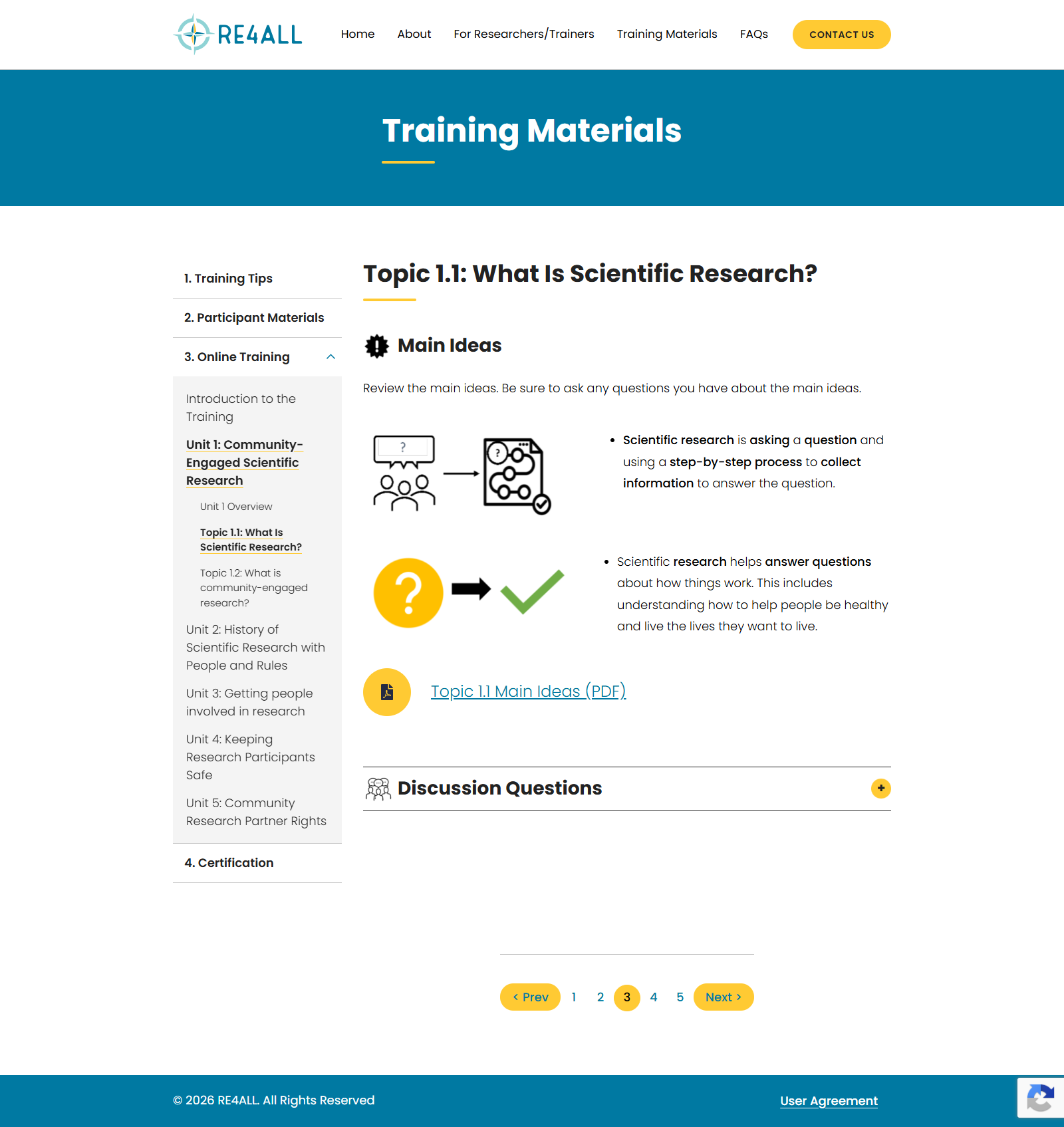
The lessons also go beyond presenting the material. After each topic, learners review key ideas and can work through discussion questions and supporting activities designed to reinforce what they have learned.
The site connects each lesson with written and video instruction, review materials, discussion questions, downloadable workbooks, and add-on activities, all within the same learning structure.
This creates a more flexible training experience while keeping the educational content consistent across formats.
Supporting Both Learners and Research Teams
RE4ALL is designed to work in more than one setting.
Some people complete the training independently. Others use it as part of a research team or facilitated group. Supporting materials therefore need to work alongside the online lessons rather than competing with them.
Workbooks and add-on activities give teams additional ways to discuss and apply the material while keeping those resources connected to the lesson they support.
This allows the same training system to support different teaching situations without creating entirely separate versions of the course.
Making Complex Institutional Information Easier to Use
RE4ALL also includes a substantial section for researchers and trainers.
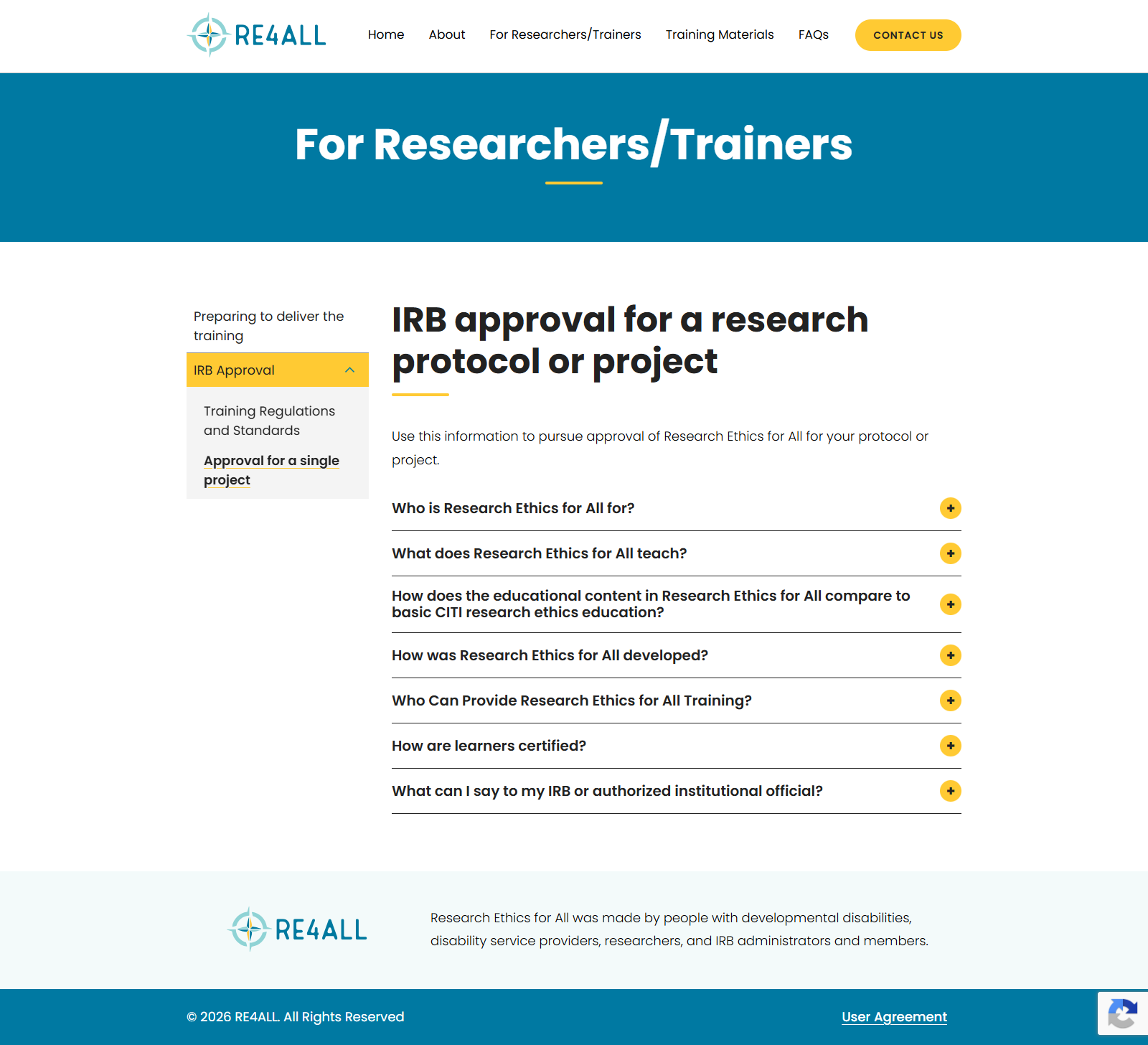
Researchers considering the program for a study may need information about IRB approval, certification, training standards, who may provide the training, and how the curriculum compares with other research ethics education.
Rather than presenting that material as one long institutional document, the content is organized into smaller, task-oriented sections and expandable questions.
Researchers can quickly locate the issue they need without requiring community learners to navigate information that is not relevant to completing the training.
Accessibility-First
A major part of the project has been the less-visible work required to make a large training system remain accessible as it grows.
That has included refining heading structures, improving navigation and anchor behavior, reorganizing training units, reviewing linked resources, and addressing accessibility issues across both the website and supporting documents.
The goal is not simply to produce individual pages that pass an accessibility check. It is to create a system in which new content can continue to follow an understandable and accessible pattern.
A Platform That Grows With the Work
RE4ALL is not a static informational website. It is a working training platform that continues to evolve as the curriculum and project expand. That means the underlying system has to support change: new training content, revised resources, additional learning pathways, and updates from the research team. My work has therefore focused not only on solving immediate accessibility and design problems, but on making the structure easier to maintain over time.
We are currently working on version two of the training, which includes a Refresher course and certification.
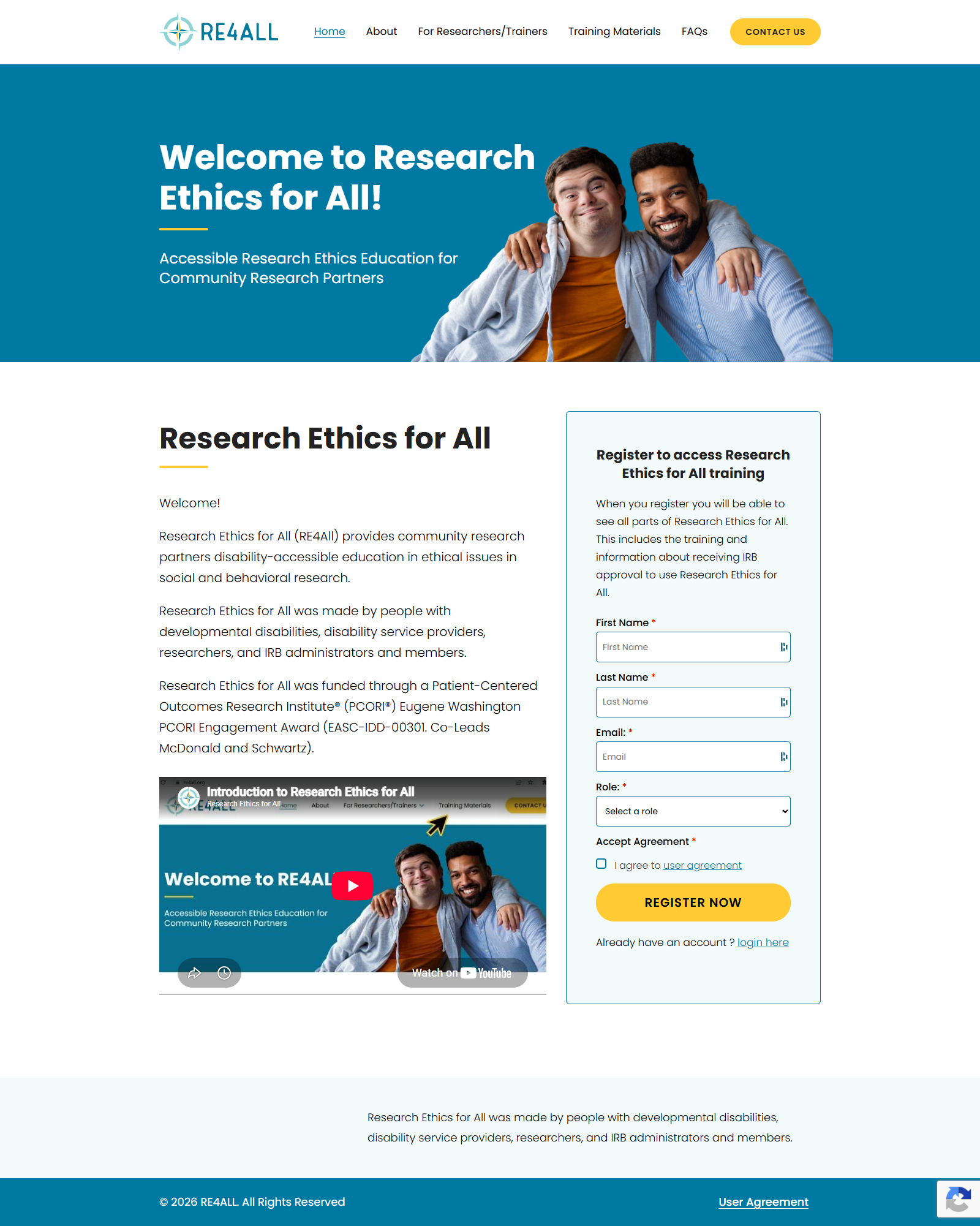
The homepage brings registration directly into the experience, giving learners a clear path from learning about the program to accessing the training.
The Result
RE4ALL now gives community research partners a clear path into a substantial research ethics curriculum and certification while also providing researchers and trainers with the institutional information and supporting materials they need to use the program.
The finished experience combines:
- structured online learning
- video and written versions of the training
- review materials and discussion activities
- downloadable workbooks and supporting resources
- accessible navigation and content organization
- registration and learner access
- guidance for researchers and trainers
- information supporting IRB review and institutional adoption
For me, this is exactly the kind of project where accessibility is most valuable: not as a layer added after the research is finished, but as part of how the research reaches the people it was created to serve.
Funded research often produces excellent content. My job is to turn that content into an accessible system people can actually use.
Planning an accessible training or dissemination project?
We work with research teams to turn funded projects into accessible websites, training platforms, and resources people can actually use.