Peer Support to Engage People with Intellectual and Developmental Disabilities (IDD) in Research helps research teams involve people with IDD as colleagues, contributors, and peer supporters.
We developed the digital toolkit to make the research team’s guidance available through an accessible HTML experience, with distinct paths for research team members with IDD and research team leaders.
Project Facts
- Project
- Peer Support to Engage People with Intellectual and Developmental Disabilities (IDD) in Research
- Project Leads
- Beth Pfeiffer and Jessica Kramer
- Institutions
- Temple University / University of Florida
- Funding
- PCORI Eugene Washington Engagement Awards: EAIN-00109 and EASC-00296
- Version Featured
- 2023 toolkit, including the transition research and services addition
- Project Type
- Accessible digital toolkit with online and downloadable offline versions
- My Role
- Software development and implementation of the digital toolkit
- Keywords
- Inclusive research · Intellectual and developmental disabilities · Peer support · Accessible resources · Research dissemination
- Website
- Explore the toolkit
The Project
Peer support draws on shared lived experience. In a research setting, someone with IDD who has experience working on a research team can help another person with IDD become involved and contribute.
The toolkit gives peer supporters and research team leaders practical guidance for making those partnerships work. Its content addresses peer support relationships, strategies, research engagement, recruitment and hiring, and the supports and accommodations people may need.
My contribution was the digital delivery: turning the team’s material into a resource people could navigate and use.
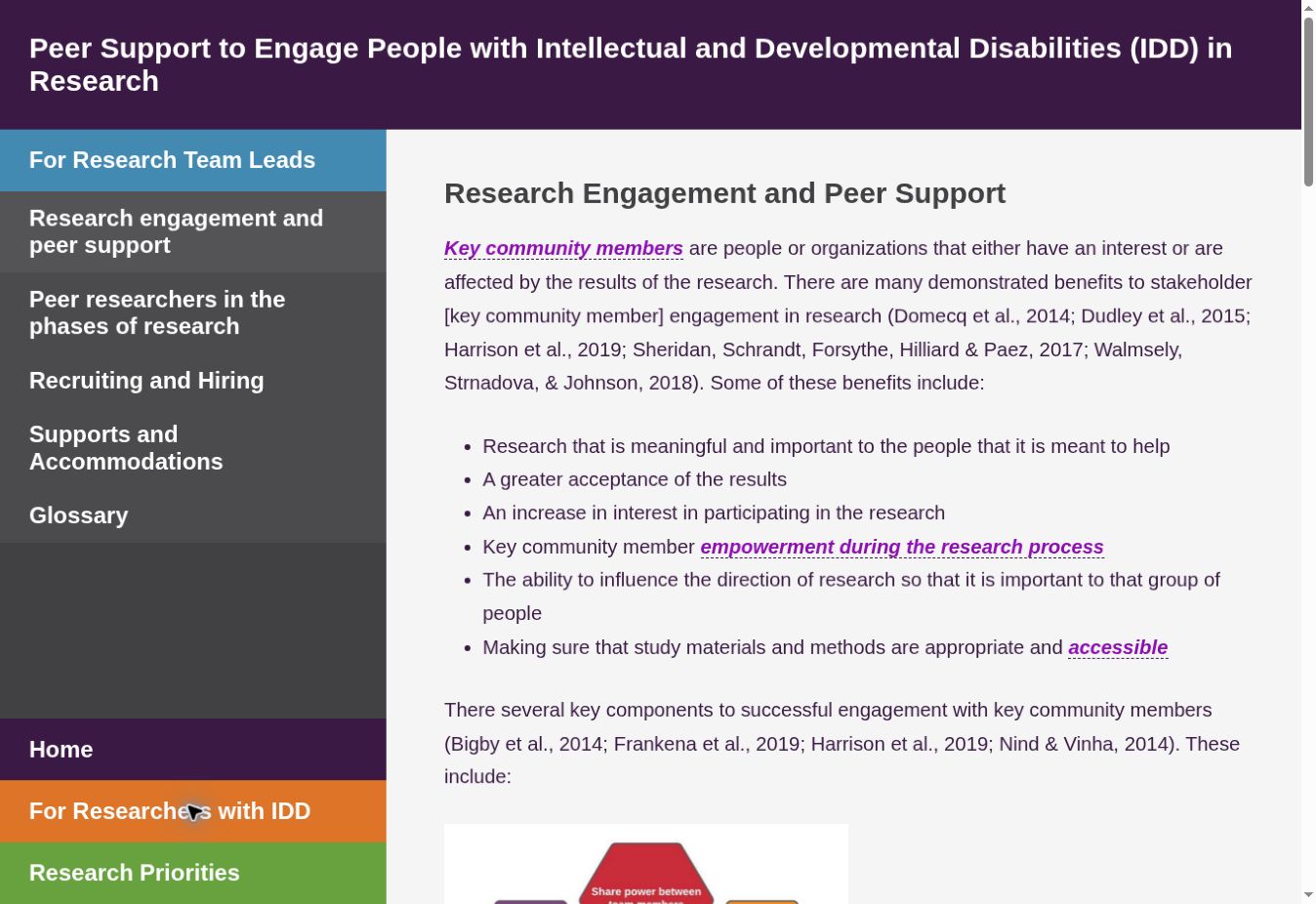
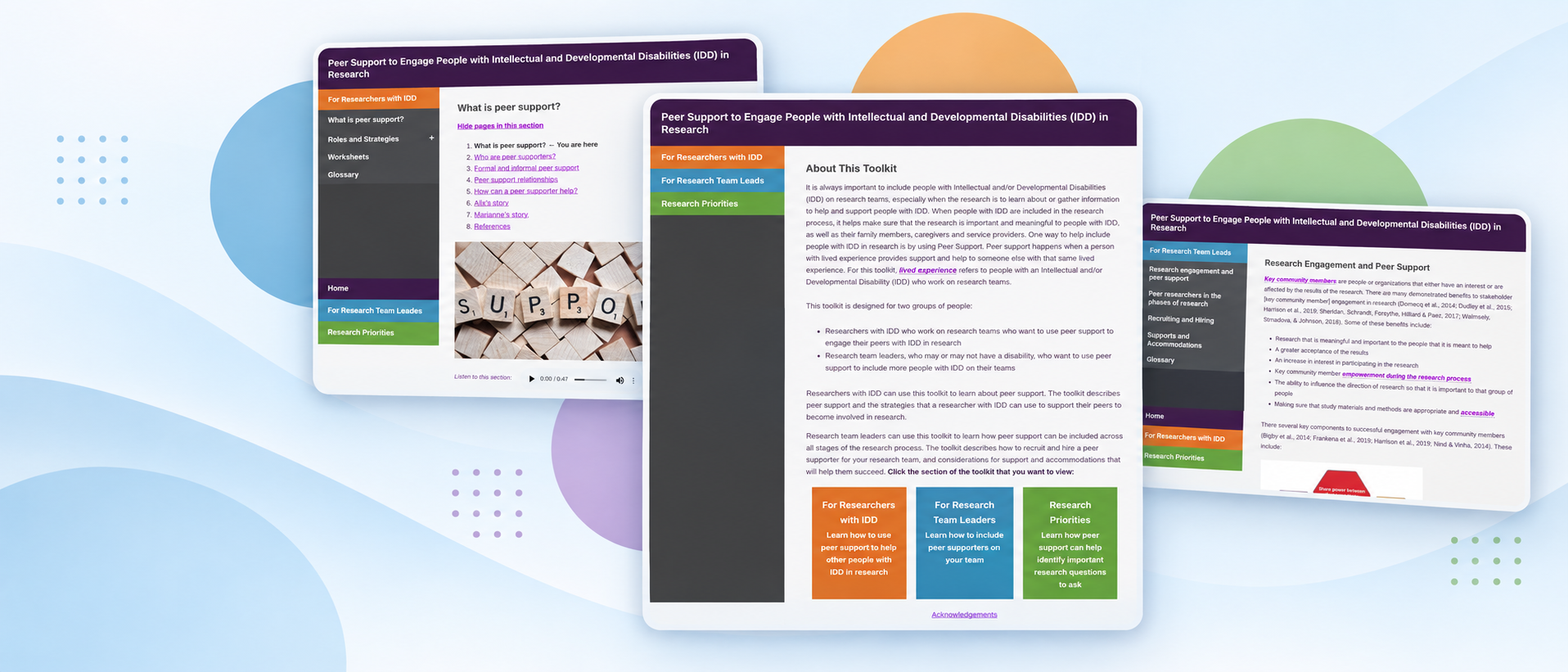
The team leader section connects research engagement with recruitment, research phases, and accommodations.
The Challenge
The toolkit serves two audiences with different questions.
Research team members with IDD need to understand what peer support means and how they can help their peers. Team leaders need guidance on bringing peer supporters into a project and supporting their work across the research process.
The digital experience needed to make those starting points clear while keeping the material connected. It also needed to support different reading preferences and remain useful when an internet connection was unavailable.
Giving Each Audience a Clear Starting Point
The opening page explains who the toolkit is for and offers separate routes for research team members with IDD and research team leaders.
That structure lets people begin with the information most relevant to their role. Peer supporters can start with an explanation of peer support, while team leaders can explore how it fits into research partnerships.
A third route introduces research priorities, connecting peer support with questions that matter to young people with IDD and their families.
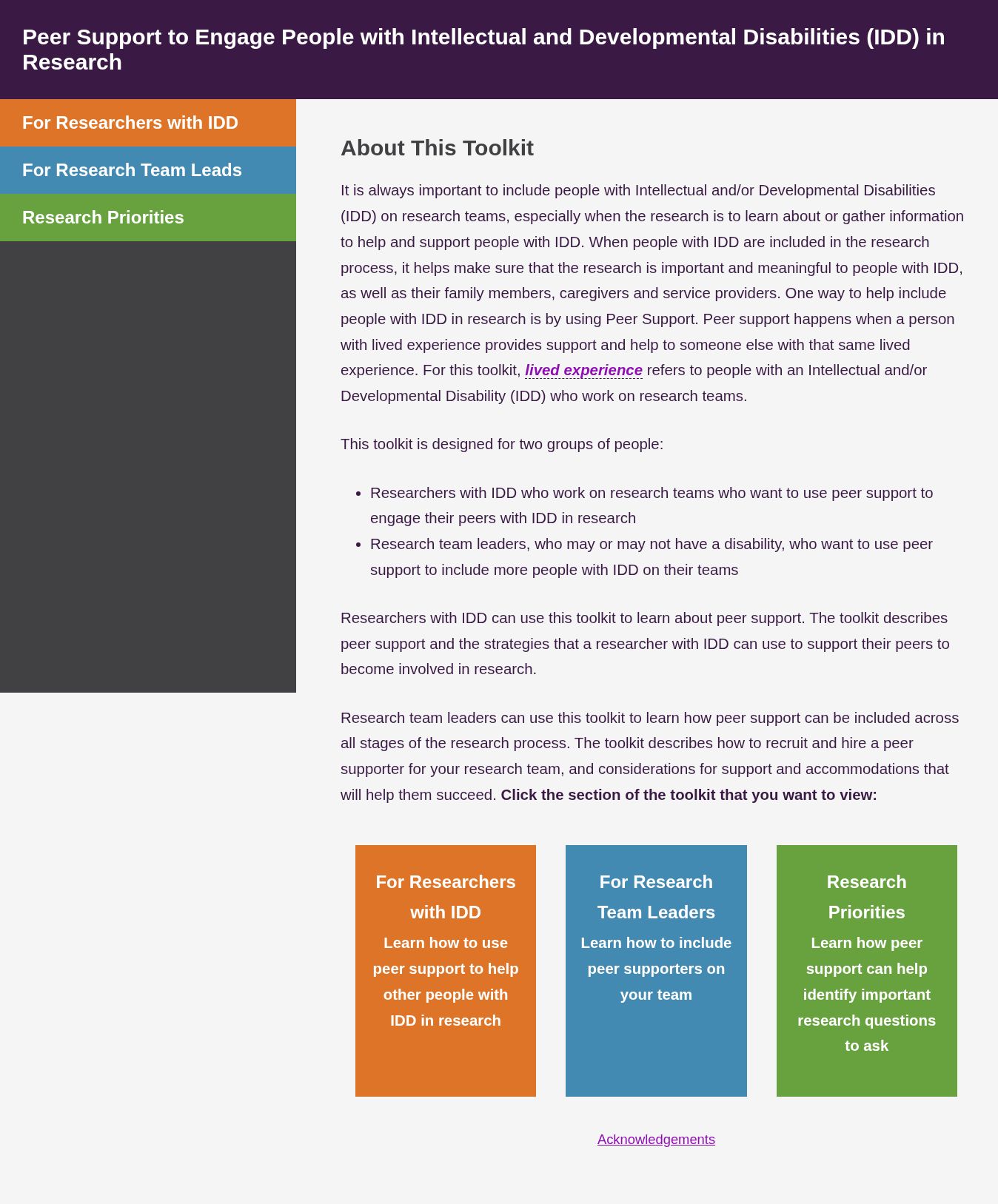
Separate entry points help research team members with IDD and team leaders find relevant guidance.
Making the Material Easier to Follow
The peer supporter section presents information in smaller topics, including relationships, ways to help, and stories illustrating peer support.
A section menu identifies the current page and lets readers move directly to another topic. Next-page links offer a guided route through the material.
These choices give readers flexibility: follow the sequence, revisit an explanation, or skip ahead to a question they need answered.
Selected sections also include audio alongside the written content. Readers can listen as well as read, giving them another way to engage with the material.
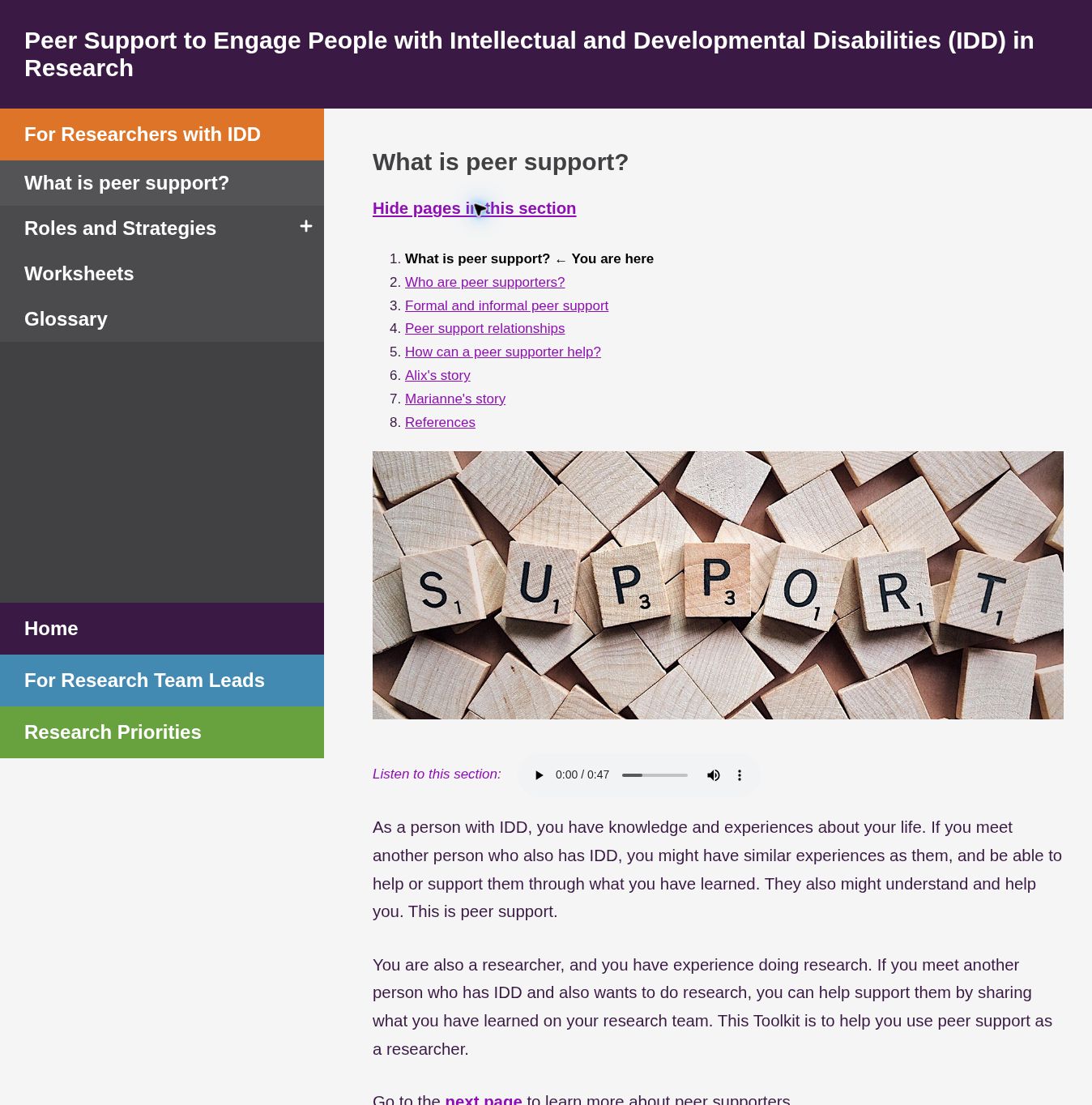
Audio and expanded topic navigation offer different ways to explore the material.
Keeping the Toolkit Available Offline
The toolkit is available online and as a downloadable HTML package.
After downloading and extracting the files, users can open the starting page locally and use the toolkit without an internet connection.
This makes distribution part of the design. A research team can share a portable resource that retains its page structure and navigation, rather than relying entirely on access to a hosted website.
The Result
The finished toolkit brings audience-specific guidance, topic navigation, audio, examples, and research priorities into one digital resource.
It gives research teams an accessible way to share the project’s work, with both online access and an offline distribution option.
For me, the value of this project is in that connection between research and use: helping a team’s knowledge become something the people it was created for can explore and apply.
Planning an Accessible Research Toolkit?
We work with research teams to turn funded projects into accessible websites, training platforms, and practical digital resources.